
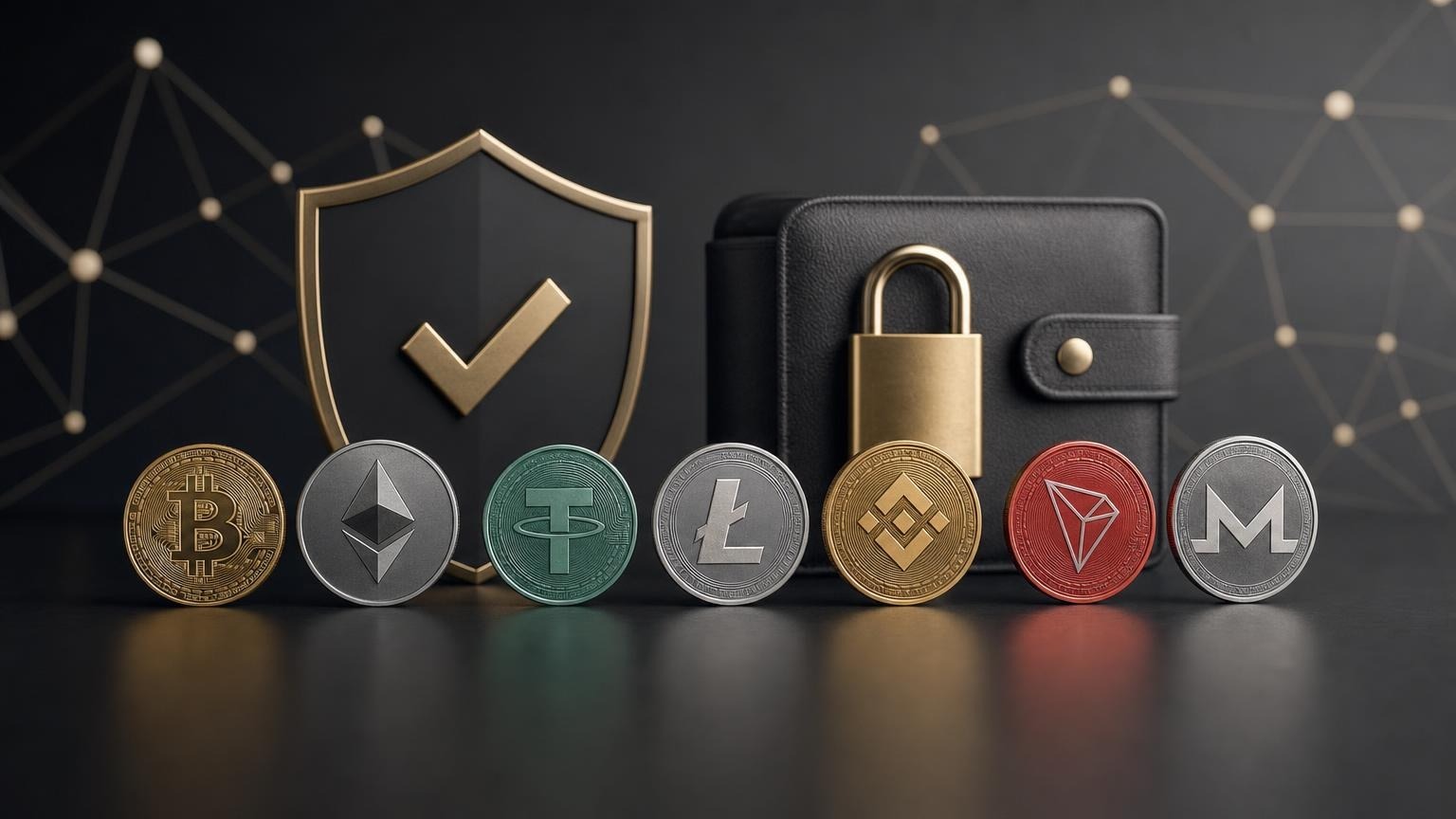
A safe exchange starts with matching four things: the exact asset, the blockchain network, the destination details and the current order terms. A familiar ticker such as BTC, ETH or USDT is not enough on its own. Before sending funds, you need to know what the receiving side accepts, what your wallet will send and which conditions apply to that particular order.
How the claim-checking protocol works
Each check below begins with the accurate version of the claim. It then gives a verdict, explains the misleading shortcut, identifies the possible harm, and shows how to verify the conclusion through an official document, a blockchain explorer or an observable field in the exchange order.
Correct statement: the asset and the network must both match
Verdict: Confirmed.
Why the simplification arises: Wallets and exchange interfaces often emphasize the asset ticker. This can suggest that selecting USDT, ETH or BNB is sufficient. In reality, some assets exist or can be transferred on more than one blockchain. Tether, for example, states that its tokens are built on multiple blockchains. Ethereum documentation also distinguishes independent networks whose balances and transaction histories do not automatically carry over from one to another. [1]
What the mistake can cause: A transfer may arrive on a network the receiving service does not support. Even when the destination address looks valid, the service may be unable to credit the order automatically or recover the funds.
How to verify it: Compare the network name shown by the sending wallet with the network specified in the active exchange order. Do not infer compatibility from the address format. Official BNB Chain guidance, for example, notes that a token sent on BNB Smart Chain will not appear under Ethereum Mainnet or opBNB simply because those systems can use similar-looking addresses. [2]
Practical takeaway: Treat “asset plus network” as one indivisible choice. If the order does not clearly name an accepted network, clarify it before creating or broadcasting a transaction.
Correct statement: a valid-looking address is not necessarily the intended address
Verdict: Confirmed.
Why the simplification arises: A wallet may reject some malformed addresses, creating the impression that every accepted string is safe. Address validation generally cannot tell you whether the address belongs to the intended recipient or whether clipboard malware has substituted another valid address.
What the mistake can cause: Confirmed cryptocurrency transfers are generally not comparable to card payments with a routine cancellation process. Bitcoin’s official introductory guidance states that a payment cannot be reversed by a central authority and can only be refunded by the recipient. Monero’s payment guide likewise describes confirmed transactions as irreversible. [3]
How to verify it: Compare the full destination shown in the order with the address displayed by the wallet immediately before approval. Check more than the first and last few characters when possible. If a hardware wallet is used, trust the address on its own screen rather than only the computer or phone display.
Practical takeaway: Copy the address from the current order, verify it after pasting and never reuse an address from an old conversation or screenshot without confirming that it still applies.
Correct statement: the final exchange result depends on the current order terms
Verdict: Depends on conditions.
Why the simplification arises: A displayed market rate or an earlier quote can be mistaken for the exact amount that will be delivered. The actual result may also depend on the quote method, order validity period, service charges, blockchain fees, minimum or maximum amount and the amount that actually reaches the deposit address.
What the mistake can cause: Sending an amount outside the stated range, after a quote has expired or without accounting for a wallet deduction can delay processing or produce a different result from the one expected.
How to verify it: Read the order summary immediately before sending. Identify the amount you must transfer, the amount expected at the destination, which fees are included or excluded, and whether the terms remain fixed for a stated period or may be recalculated. If a field is absent or ambiguous, do not invent an answer from a rate shown elsewhere.
Practical takeaway: Base the decision on the final order preview, not on a banner, calculator result or quote saved earlier.
Correct statement: completion time cannot be guaranteed from the coin name alone
Verdict: Misleading when stated as a fixed speed.
Why the simplification arises: Descriptions such as “fast coin” combine several separate stages into one promise. A transfer must be broadcast, included in the relevant blockchain, receive the confirmations required for that direction and then pass the service’s processing and any applicable compliance checks.
What the mistake can cause: A user may assume that an order has failed, create a duplicate order or send funds again while the original transaction is still pending.
How to verify it: After sending, locate the transaction hash in the wallet and inspect it in the appropriate blockchain explorer. Check whether the transaction is pending, confirmed or failed. Then compare that on-chain state with the order status. Bitcoin documentation explains that confirmations accumulate over time and that block discovery is probabilistic rather than bound to a guaranteed minimum or maximum delay. [4]
Practical takeaway: Track the transaction hash before taking corrective action. Network confirmation and exchange completion are related stages, but they are not the same event.
Correct statement: privacy properties do not make an exchange operation fully anonymous
Verdict: Misleading when anonymity is presented as absolute.
Why the simplification arises: People may transfer a privacy description from a blockchain protocol to every website, wallet and counterparty involved in an exchange. Those layers do not collect or expose information in the same way.
What the mistake can cause: A user may underestimate the records created by an order, the information visible to the counterparty, the public nature of some blockchains or the possibility of compliance checks.
How to verify it: Separate on-chain visibility from service-side data. Bitcoin transactions are recorded on a public ledger, although an address does not automatically reveal its owner’s identity. Monero’s official guide states that public observers cannot see important transaction details such as the sender address, amount and recipient address, while the recipient still knows details relevant to receiving the payment. [3] Review the service’s current privacy and verification terms separately.
Practical takeaway: Do not interpret “private transaction” as “no records, no counterparty information and no possible checks.”
Correct statement: support for an asset does not prove that every pair or network is available
Verdict: Not confirmed until checked in the live order interface.
Why the simplification arises: An asset list can be read as a promise that any listed coin can be exchanged for any other listed coin through every network and direction.
What the mistake can cause: A user may acquire or send an asset before discovering that the required pair, direction or network is not currently offered.
How to verify it: Select the sending asset, receiving asset and required direction in the current order form. Confirm that the relevant network is explicitly offered. The service works with assets including BTC, ETH, USDT, LTC, BNB, TRX and XMR and is gradually adding assets, but this does not establish universal availability of pairs or networks.
Practical takeaway: Check availability before moving funds into the sending wallet. A general asset list is informational; the active order form determines whether a specific exchange can be created.
Once these checks are complete, the next step is to review the currently available exchange conditions for the exact assets, direction and network you intend to use.
Where an honest answer depends on context
Verification requirements: The necessary checks can differ by exchange direction and by the outcome of compliance screening. A previous transaction does not prove that a new order will have identical requirements. Review the current conditions before creating each order and provide information only through the service’s genuine interface.
Confirmations: There is no universal confirmation number that should be assumed for BTC, ETH, USDT, LTC, BNB, TRX and XMR together. Networks have different designs, and a receiving service may apply its own threshold according to the asset, network, amount and risk controls. The relevant number is the one stated for the active deposit.
Rates, fees and limits: These are dynamic order conditions rather than permanent properties of an asset. They may change between directions or over time. A defensible answer therefore comes from the final order screen, not from an old article, message or screenshot.
Local rules: Cryptocurrency reporting, taxation and permitted payment methods vary between countries and sometimes between regions. This article cannot determine an individual user’s legal or tax obligations. If those obligations are unclear, consult the official authority responsible for the user’s jurisdiction.
Planned payment methods: Exchanging Russian rubles from a bank card into cryptocurrency and back is planned, but it should not be treated as a currently operating route and no launch date should be assumed. Availability must be established from the live interface rather than from references to future development.
Final safety checks not covered by the claims above
- Open the service independently. Avoid exchange pages reached through unsolicited messages, search advertisements or look-alike social media accounts. Phishing pages may copy branding while replacing deposit details.
- Do not disclose wallet secrets. A legitimate transfer may require a public address or transaction hash, but not a seed phrase or private key. Anyone with those secrets may gain control of the wallet.
- Check for an additional destination identifier. If the receiving instructions specify a memo, tag, payment identifier or another reference, copy it exactly. Do not add one based on assumptions, and do not omit one when the active order requires it.
- Keep the order record. Save the order identifier, asset, network, destination, amount and transaction hash. These details help distinguish a pending blockchain transaction from an order-processing issue without exposing private keys.
- Consider price movement before committing. BTC, ETH, LTC, BNB, TRX and XMR can change in market value. Even assets designed to track a reference value should not be treated as carrying a universal guarantee from every wallet, platform or counterparty. Decide whether the quoted terms remain acceptable without relying on a price prediction.
- Pause if the instructions change unexpectedly. A request to replace the address after payment, send an extra “unlocking” transfer, share a screen or install remote-access software is a reason to stop and verify the communication through the service’s official channel.
The most reliable pre-exchange routine is short: confirm that the exact pair and network are available, read the current order terms, verify every destination field, and retain the transaction hash. These checks cannot remove volatility, blockchain delays or compliance uncertainty, but they reduce avoidable errors that are difficult or impossible to correct after a transaction has been confirmed.